At CES 2026, Nvidia pushes ‘physical AI’ as chipmakers and robot demos dominate Day 1
CES 2026 opened with a heavy focus on artificial intelligence, with Nvidia unveiling ‘physical AI’ concepts and new models, AMD touting new Ryzen AI chips, and multiple companies showcasing robots and autonomous vehicle partnerships amid a broader push to commercialize AI hardware and services.
- PUBLISHED
- UPDATED
LAS VEGAS — Day 1 of CES 2026 put artificial intelligence at the center of nearly every major announcement, as chipmakers and consumer tech companies pitched a near-future built on AI-driven devices, robots and autonomous transportation.
Nvidia, AMD and Intel anchored the day with chip and platform updates, but the show’s energy came from the demonstration floor: small robots, humanoid prototypes and self-driving concepts that companies hope will convert AI hype into products consumers and businesses can actually buy.
Nvidia bets on ‘physical AI’
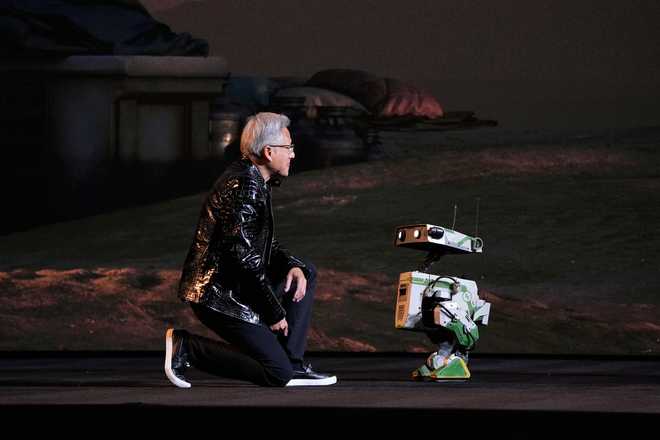
Nvidia CEO Jensen Huang leaned into the company’s vision of “physical AI,” describing systems trained in simulated, physics-based virtual environments using synthetic data and then deployed into real-world machines once they have learned tasks safely and at scale.
Nvidia highlighted Cosmos, described as a foundation model aimed at simulating environments governed by real physics, and introduced Alpamayo, an AI model positioned for autonomous driving. Huang also said the next-generation Vera Rubin AI superchip platform is in full production and pointed to a new partnership with Siemens.
AMD, Intel and a revived chip race
AMD used the CES stage to push deeper into AI PCs, rolling out a new line of Ryzen AI processors and unveiling the Ryzen 7 9850X3D aimed at gamers. The message: AI acceleration and performance tuning are no longer niche features but baseline expectations for next-generation personal computers.
Intel, meanwhile, showcased its upcoming Panther Lake chip and a new handheld gaming platform as it continues trying to regain manufacturing momentum and defend its relevance in an increasingly AI-optimized market.
Robotaxis and robots everywhere
Uber returned to the robotaxi conversation with a preview of an autonomous vehicle built with Lucid Motors and Nuro, emphasizing a customized in-cabin experience designed to make self-driving rides feel like a premium product rather than a science experiment.
Across CES, robotics also served as a crowd magnet. Demonstrations ranged from humanoid assistants pitched for the home to industrial robots tied to manufacturing ambitions, reinforcing that consumer-facing AI is increasingly being sold through physical form factors rather than just apps and chat interfaces.
The big takeaway
CES 2026’s first day reinforced a shift underway in tech: AI is being repositioned from an abstract software layer into an end-to-end product strategy that spans chips, models, sensors and machines — with companies racing to define what the “AI device” era should look like.
Whether consumers embrace robot helpers and autonomous rides at scale remains uncertain, but the show’s message was clear: the industry is betting that the next wave of growth comes from making AI tangible, visible and embedded in everyday hardware.